


Introduction
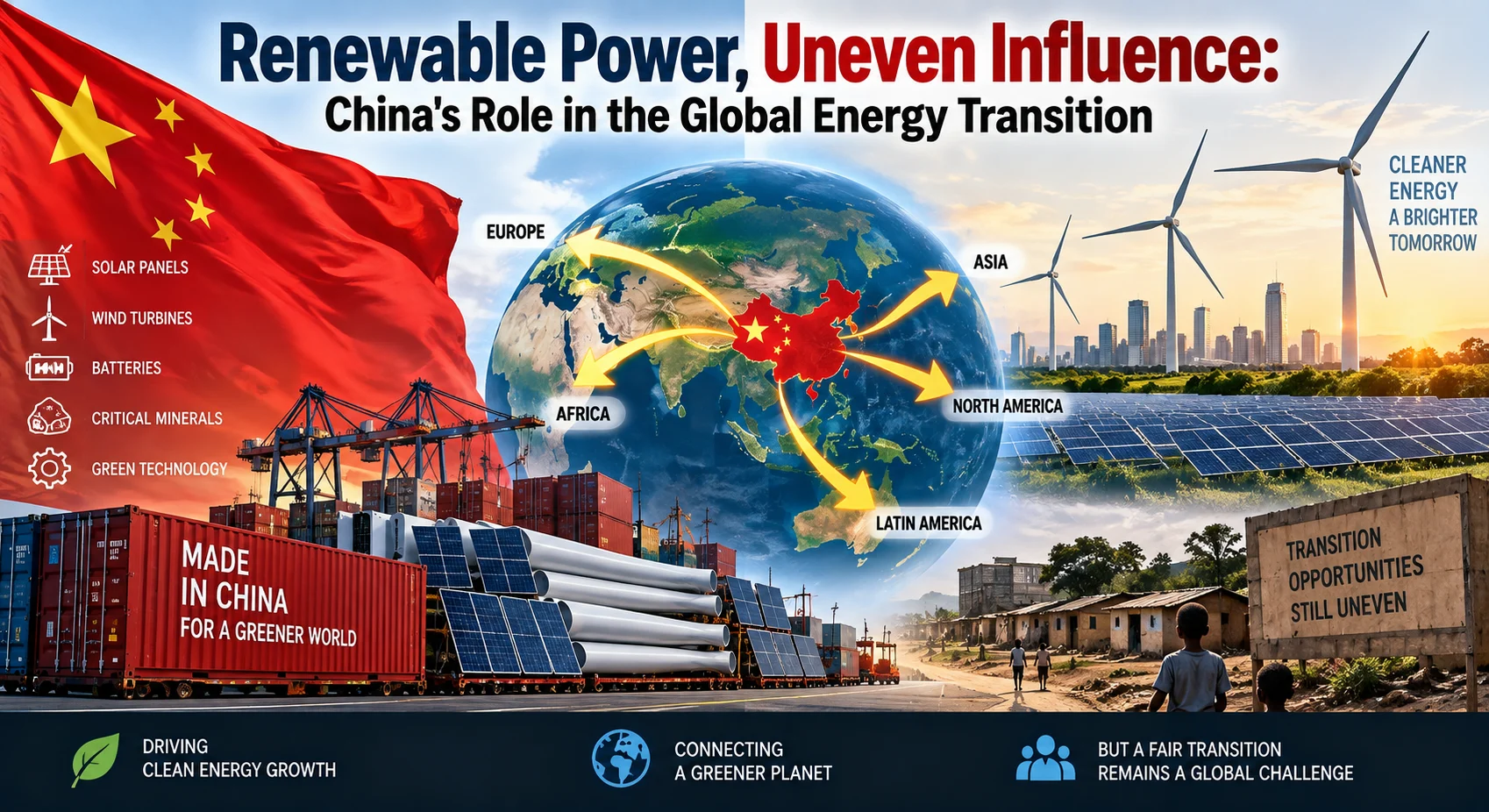
China has become the world’s leading manufacturer of clean energy technologies, producing over 80 per cent of global solar panels while controlling significant shares of battery manufacturing and critical mineral processing (International Energy Agency [IEA], 2022). As countries accelerate their energy transitions, this manufacturing strength is giving China a growing source of geopolitical influence. The question is not whether China leads the renewable energy economy, but how that leadership shapes its relationships with other countries. Much of the existing literature explains China’s expanding role through the idea of green soft power—the ability of states to build influence through climate leadership and environmental cooperation (Nitza-Makowska et al., 2024). While this perspective captures China’s growing prominence in renewable energy, it is less useful for explaining why governments choose to work with Chinese firms and institutions. Those decisions are often tied to more concrete
considerations: access to affordable technology, financing, manufacturing capacity, and infrastructure. China’s influence therefore rests substantially on what it can provide, particularly to countries pursuing rapid industrialisation and energy transition (Qi & Dauvergne, 2022). This article argues that China’s growing influence in the energy transition is driven primarily by what it can deliver rather than by environmental attraction alone. Across much of the Global South, Chinese investment is welcomed because it supports energy access, industrialisation, and economic development. In Europe, however, the same economic capabilities increasingly raise concerns over strategic dependence and supply chain security. China’s influence is therefore uneven: the same technologies and investments can be viewed
as development opportunities in one region and strategic vulnerabilities in another.
China’s Development Advantage in the Global South
Across much of the Global South, China has become a leading partner in the energy transition by providing renewable energy technology, financing, and infrastructure at scale. Chinese policy-bank financing has been particularly significant in renewable-energy projects across developing countries, including countries with limited access to conventional development finance (Cheng & Wang, 2023).
Indonesia illustrates this clearly. Since 2023, Chinese companies, including CATL, have invested billions of dollars in an integrated battery complex linking Indonesia’s nickel reserves to global EV supply chains. CATL’s US$5.9 billion Karawang battery plant supports domestic nickel processing, creates employment, and advances Indonesia’s ambition to become a regional EV manufacturing hub (CELIOS, 2025). Despite concerns over environmental impacts and the distribution of benefits, Indonesian policymakers have continued to present these investments as opportunities for industrial development and SouthSouth cooperation (SAIIA, 2024).
Ethiopia tells a similar story. Chinese financing has supported the expansion of solar energy and major hydropower projects, helping address electricity shortages and supporting the country’s transition towards electric mobility, including its 2024 ban on gasoline vehicle imports (Ecofin Agency, 2025). These projects strengthen Ethiopia’s energy infrastructure while supporting its wider development and electrification goals.
Laos demonstrates the same pattern. In 2025, China Power Construction completed a major monsoon wind project under the Belt and Road Initiative, expanding electricity generation, improving grid connectivity, and creating rural employment (Mai & Natalegawa, 2025). While concerns over debt sustainability and environmental governance remain, Chinese investment continues to play an important role in Laos’s renewable-energy infrastructure.
Chinese investment is not without challenges. Concerns over debt sustainability, environmental standards, and growing economic dependence have emerged in several recipient countries. Yet these concerns have not consistently displaced Chinese investment, in part because affordable alternatives in technology, financing, and infrastructure remain limited (Qi & Dauvergne, 2022).
The Global South therefore illustrates how China’s clean-energy capabilities can translate into development partnerships. Governments work with China not simply because of its environmental messaging, but because Chinese technology, financing, and infrastructure can address immediate development needs. Europe shows that the same capabilities can generate a very different response when they are viewed through the lens of strategic dependence.
Europe: Cooperation Meets Strategic Competition
Europe’s relationship with China in the energy transition presents a different picture. China remains a major supplier of solar panels, batteries, and other clean-energy technologies, making it an important part of Europe’s energy transition. At the same time, European policymakers increasingly view concentrated dependence on Chinese supply chains as a strategic and industrial vulnerability. The European Commission has identified China’s dominance in areas such as photovoltaic supply chains and critical raw materials as a source of strategic dependence and has called for greater diversification and domestic manufacturing capacity (European Commission, 2024).
This shift is visible in Europe’s trade and industrial policies. In October 2024, the European Union imposed definitive countervailing duties on Chinese battery electric vehicles following an anti-subsidy investigation, with rates ranging from 7.8 to 35.3 per cent depending on the producer. The EU has also pursued measures to strengthen domestic clean-energy manufacturing and reduce supply-chain vulnerabilities. The European Solar Charter, for example, explicitly identifies Europe’s dependence on a limited number of suppliers, with
China accounting for most solar-module imports, and calls for a more resilient European solar value chain (European Commission, 2024).
These measures do not amount to disengagement from China. Instead, they reflect an attempt to reduce strategic exposure while retaining access to Chinese technologies and global markets. European governments continue to rely on Chinese technology while
simultaneously pursuing supply-chain diversification, domestic manufacturing, and stronger economic-security measures. Unlike many developing economies, Europe evaluates Chinese engagement not only in terms of economic benefits but also through industrial competitiveness, economic security, and geopolitical risk (Böhme et al., 2025).
The comparison with the Global South is revealing. China supplies many of the same technologies and investments to both regions, yet the political response differs because the priorities differ. Where governments prioritise development and energy access, Chinese
investment is more readily welcomed. Where governments prioritise strategic resilience and economic security, the same capabilities are increasingly viewed with caution.
Conclusion
China’s influence in the global energy transition stems primarily from its ability to provide renewable-energy technologies, financing, and infrastructure at scale. Across much of the Global South, these capabilities support industrial development, energy access, and economic growth. In Europe, the same capabilities have encouraged efforts to reduce strategic dependence while maintaining access to critical technologies.
The contrast between these regions highlights the central argument of this article: China’s influence is rooted substantially in what it can deliver, while its political effects depend on the priorities of the countries receiving that investment and technology. The same Chinese
capabilities can therefore generate cooperation in one setting and strategic caution in another.
As competition over clean-energy technologies intensifies, manufacturing capacity, critical supply chains, and infrastructure are becoming increasingly important sources of international influence. China’s experience shows that technological and economic
advantages can translate into geopolitical influence even when the political response to Chinese engagement remains sharply divided.
References:
- Böhme, S., Stünzi, A., & Thaler, P. (2025). China and the EU: Partnering and competing in the global net-zero transition. Heinrich Böll Foundation.
https://www.boell.de/en/2025/11/05/china-and-eu-partnering-and-competing-globalnet-zero-transition - CELIOS. (2025). China–Indonesia energy transition cooperation: Progress, prospects, and recommendations. https://celios.co.id/china-indonesia-energy-transitioncooperation-progress-prospects-and-recommendations/
- Cheng, S., & Wang, B. (2023). Impact of the Belt and Road Initiative on China’s overseas renewable energy development finance: Effects and features. Renewable Energy, 206, 1036–1048. https://ideas.repec.org/a/eee/renene/v206y2023icp1036-1048.html
- Ecofin Agency. (2025). Ethiopia expands vehicle import ban to trucks, pushing electric transport. https://www.ecofinagency.com/news-industry/0810-49366-ethiopia-expands-vehicle-import-ban-to-trucks-pushing-electric-transport
- European Commission. (2024, May 15). Focus on clean energy technologies. Directorate-General for Energy. https://energy.ec.europa.eu/news/focus-clean-energytechnologies-2024-05-15_en?utm_source=chatgpt.com
- International Energy Agency. (2022). Solar PV global supply chains. IEA.
https://www.iea.org/reports/solar-pv-global-supply-chains - Mai, L., & Natalegawa, A. (2025, December 17). Chinese energy investments in Southeast Asia. Center for Strategic and International Studies.
https://www.csis.org/analysis/chinese-energy-investments-southeast-asia - Nitza-Makowska, Longhurst K., & Skiert-Andrzejuk K. (2024). Green soft power? Checking in on China as a responsible stakeholder. Polish Political Science Yearbook, 53(1), 17-33.
https://www.researchgate.net/publication/380150124_Green_Soft_Power_Checking_in_on_China_as_a_Responsible_Stakeholder - Qi, J. J., & Dauvergne, P. (2022). China’s rising influence on climate governance: Forging a path for the Global South. Global Environmental Change, 73, 102484.
https://www.sciencedirect.com/science/article/abs/pii/S095937802200022X?via%3Dihub - SAIIA. (2024). China’s climate and energy partnerships in the Global South. South African Institute of International Affairs. https://saiia.org.za/research/chinas-climateand-energy-partnerships-in-the-global-south/
- Sattich, T., Freeman, D., Scholten, D., & Yan, S. (2021). Renewable energy in EU–China relations: Policy interdependence and its geopolitical implications. Energy Policy, 155, 112456.
https://www.sciencedirect.com/science/article/pii/S0301421521003268?via%3Dihub - Zhang, Z. (2025, December 4). China’s EV dominance sparks EU retaliation. East Asia Forum. https://eastasiaforum.org/2025/12/04/chinas-ev-dominance-sparks-euretaliation/