
Introduction
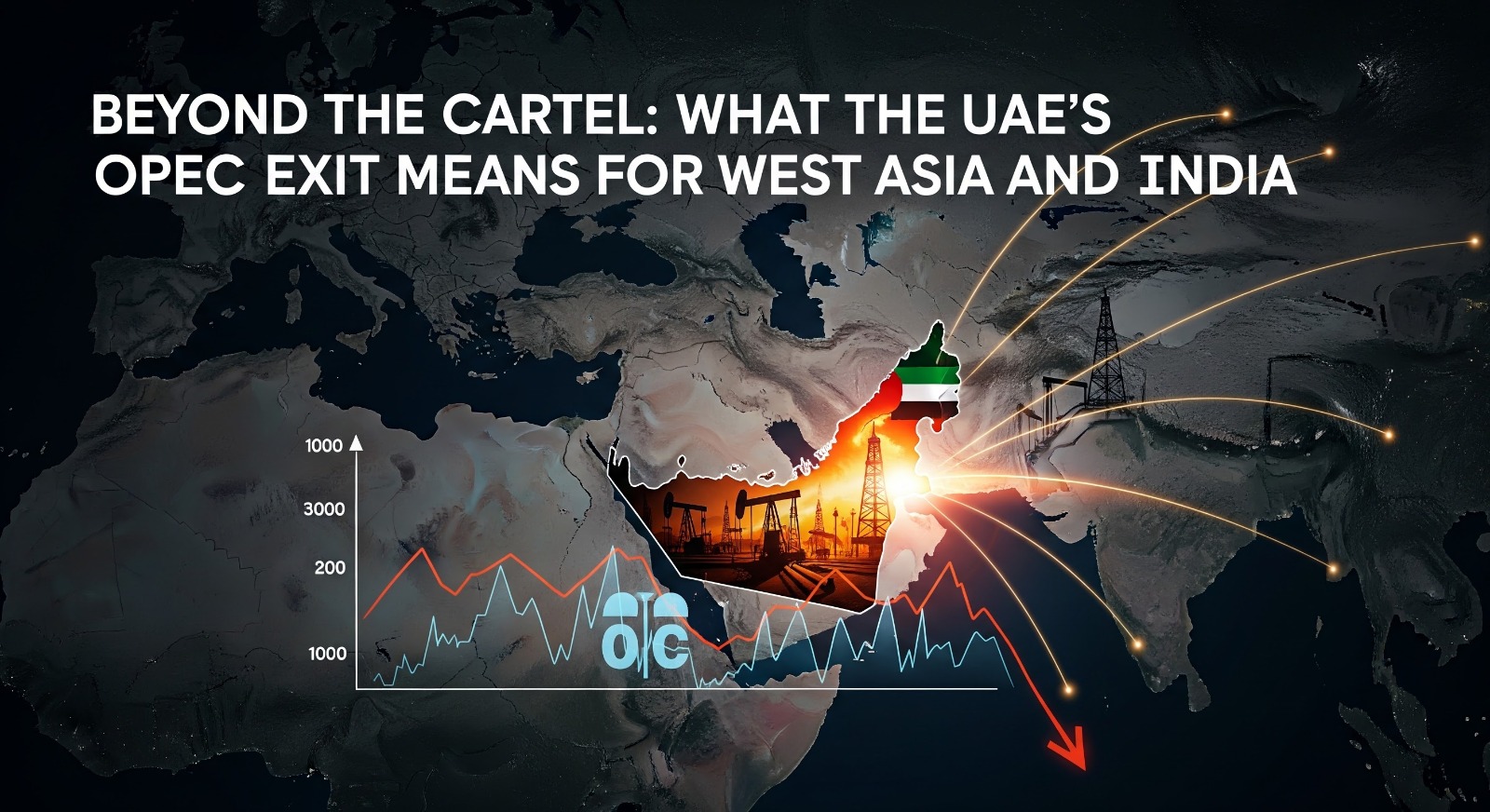
On 28 April 2026, the United Arab Emirates (UAE) announced its withdrawal from the Organization of the Petroleum Exporting Countries (OPEC) and the broader OPEC+ alliance, effective 1 May 2026. As per the UAE Ministry of Energy, the decision was taken after a comprehensive review of its production policy and capacity in the national interest. After nearly six decades of membership, Abu Dhabi, having joined in 1967, the departure is the most consequential defection in the cartel’s history.
The UAE was OPEC’s fourth-largest producer, contributing approximately 12 per cent of total OPEC supply. Its exit is neither merely economic nor sudden; it is the culmination of structural grievances, a wartime security shock, and a deepening strategic rivalry with Saudi Arabia, set against an Iran-centred conflict that has fundamentally redrawn West Asia’s geopolitical map. For India, the world’s third-largest crude oil consumer, with over 85 per cent of its oil imports, the event carries implications spanning energy security, inflation management, and bilateral diplomacy. Notably, India and the UAE have signed the Agreement on Oil Storage and Management between Indian Strategic Petroleum Reserves Limited (ISPRL) and Abu Dhabi National Oil Company (ADNOC) in January 2017 and the Letter of Intent on the Strategic Defence Partnership in January 2026.
1. The Long Road to Exit: Structural and Strategic Grievances
The UAE’s discontent with OPEC’s quota architecture predates the current conflict by several years. Abu Dhabi National Oil Company (ADNOC) has invested approximately US$ 150 billion to expand sustainable production capacity from approximately 3.5 million barrels per day (mbpd) to 4.85 mbpd by 2024, with an official target of 5 mbpd by 2027. Under the OPEC+ agreement, however, the UAE was constrained to produce around 3.6 mbpd, approximately 30 per cent below its installed capacity. The first public rupture came in 2021, when OPEC+ negotiations stalled after the UAE challenged the baseline used to calculate its quota. The eventual compromise, raising the baseline from 3.17 mbpd to 3.5 mbpd from May 2022, only partially accommodated the UAE’s capacity growth.
Beyond the arithmetic of barrels, there is a deeper structural and strategic divergence. Saudi Arabia’s fiscal breakeven is significantly higher than the UAE’s, with Reuters reporting IMF estimates of about US$ 90 per barrel for Saudi Arabia and about US$ 50 per barrel for the UAE. In Abu Dhabi, OPEC+ has increasingly perceived as constraining Emirati production ambitions, with quota setting widely perceived as reflecting Saudi-led oil governance more than the UAE’s capacity-expansion strategy. UAE Energy Minister Suhail al-Mazrouei publicly signalled this strategic orientation as early as 2022, stating that oil demand is in decline mode amid efforts for green transition and that assuming oil permanence is ‘wishful thinking’. The UAE’s longer-term calculus seems to be monetise its reserves before peak oil demand erodes their value, a calculation incompatible with production restraint.
2. The Iran War as Catalyst and the Saudi–Emirati Fracture
The U.S.–Israel military operations targeting Iran, launched in February 2026, served as the immediate catalyst for Abu Dhabi’s decision. Iranian strikes hit Fujairah’s industrial zone and Jebel Ali port, sending smoke over Dubai’s skyline. The UAE absorbed much of this damage unilaterally. Moreover, security concerns were intertwined with an already deteriorating bilateral relationship. The Saudi–UAE coalition in Yemen, once the most visible expression of Gulf solidarity, fractured progressively as the two states backed opposing factions. On 29 December 2025, Saudi Arabia carried out the strike and claimed that the bombardment targeted ‘weapons and combat vehicles’ unloaded from two ships arriving from the port of Fujairah in the UAE.
Economically, Saudi Arabia and the UAE have increasingly competed for investment, logistics, regional headquarters, and strategic commercial influence, even as their trade links remain deep. In that context, remaining within an OPEC architecture widely perceived as Riyadh-centred would have meant a form of institutional constraint for Abu Dhabi.
3. Implications for OPEC and the Gulf Regional Order
The institutional damage to OPEC is severe. The UAE’s departure removes the cartel’s only significant swing producer besides Saudi Arabia, one with the most modern national oil company in the bloc, the lowest fiscal breakeven, and the greatest spare capacity after the Kingdom. Qatar left OPEC in 2019 as a marginal oil producer to focus more on gas production; Angola departed in 2024 over output quota disputes. The UAE’s departure represents a materially significant shift compared to earlier exits. As one of OPEC’s largest producers, it contributed roughly 11–12 per cent of the group’s total output prior to withdrawal, positioning it as a central actor in the cartel’s supply management framework; its exit therefore carries structural implications for OPEC’s production capacity, cohesion, and market leverage, rather than being a marginal adjustment.
OPEC’s influence in global oil markets has steadily weakened since its peak, when it controlled over half of global output after its formation in 1960. Today, its share has fallen to roughly 30 per cent of the world’s 105 million barrels per day oil and liquids production, largely due to rising output from competitors. Most notably, the United States has emerged as a major rival over the past 15 years, boosting its production to about 20 per cent of global supply through the shale oil boom. In response to this shift, OPEC partnered with non-OPEC producers in 2016 to form OPEC+, significantly expanding its collective influence, reaching around 50 per cent of global production by 2025. However, with the UAE’s exit, this combined share is expected to decline to approximately 45 per cent.
In global terms, the UAE produces around 3 per cent of total crude oil, underscoring its significance not only within OPEC but in the wider energy market. Its exit, therefore, represents not a marginal loss of membership but a structural weakening of coordinated supply governance. Each departure has been framed as idiosyncratic; the cumulative pattern is a cartel being hollowed out from within by strategic divergence. Saudi Arabia will now bear a disproportionate burden for price stabilisation, steward a structurally weakened organisation, and face the additional competitive pressure of an unconstrained UAE ramping toward 5 mbpd in the post-conflict market.
4. The Hormuz Dimension: Immediate Market Reality
The immediate market impact of the UAE’s OPEC exit is muted because the Strait of Hormuz remains heavily disrupted. The IEA says roughly 20 million barrels per day, or about a quarter of world seaborne oil trade, normally transits the strait, and it has described the resulting shock as the largest disruption in the history of the global oil market. Notably, the UAE’s Fujairah/ADCOP bypass route can carry about 1.5–1.8 million barrels per day, which gives Abu Dhabi some export flexibility outside Hormuz. In that sense, the UAE’s exit is best understood as structural positioning for the post-conflict period: if shipping normalises, greater Emirati production autonomy could add supply and ease prices over time.
5. India’s Stakes: Risks and Strategic Opportunities
India’s exposure to this unfolding order is acute. The country consumes approximately 5.5 mbpd of crude oil, meeting over 85 per cent of its requirements through imports. According to data from the Petroleum Planning and Analysis Cell, the prices of the Indian crude basket price was US$ 70.70 per barrel as of 19 February 2026 and trending higher amid escalating West Asian tensions, suggesting continued pressure on India’s import bill, inflation trajectory, and fiscal stability.
Around 40 per cent of India’s crude oil imports pass through the Strait of Hormuz, leaving the country highly vulnerable to both price fluctuations and disruptions along this critical maritime route. Hence, in the near term, India’s primary vulnerability remains the Hormuz blockade, not the UAE’s OPEC status. The Government of India has responded by diversifying imports across approximately 40 source countries, issuing a Natural Gas Control Order under the Essential Commodities Act in March 2026, and establishing a 24-hour control room to monitor developments.
Over the medium term, however, the UAE’s OPEC exit may represent a strategic dividend for India. The two countries share one of the most comprehensive bilateral economic architectures in the region, the India–UAE Comprehensive Economic Partnership Agreement (CEPA), signed in May 2022, under which bilateral trade has grown from US$ 43.3 billion in FY 2020–21 to US$ 100.06 billion in FY 2024–25, ranking the UAE as India’s third-largest trading partner and second-largest export destination.
India cannot simply absorb a large additional volume of UAE crude because the UAE’s export grades are not a perfect fit for every Indian refinery, and India already has the flexibility to source comparable light crude elsewhere. Still, the UAE’s exit from OPEC could give Abu Dhabi more room to pursue bilateral energy deals with India, including longer-term contracts and pricing innovation.
Indian public sector oil marketing companies, Indian Oil, Bharat Petroleum, and Hindustan Petroleum, have active partnerships with ADNOC. Post-conflict, an unconstrained UAE moving toward 5 mbpd could negotiate supply arrangements outside the rigidity of OPEC quotas, may potentially offer India higher volumes at more competitive prices through direct bilateral frameworks. The CEPA architecture may provide the institutional scaffolding for precisely this kind of flexible, long-term energy diplomacy.
India’s strategic positioning is further reinforced by the I2U2 multilateral framework, comprising India, Israel, the UAE, and the United States, which has been deepening economic and technological cooperation since 2022. This grouping provides a structural architecture for continued collaboration even as West Asian security arrangements are redrawn. Over 3.5 million Indian nationals reside in the UAE, contributing to nearly 19.2 per cent of India’s total inward remittances, a human and economic dimension that further deepens New Delhi’s stake in Abu Dhabi’s stability and strategic success.
Conclusion
The UAE’s departure from OPEC is not a routine adjustment in the architecture of global energy governance. It reflects a widening Gulf divergence between the UAE’s geo-economic, market-oriented strategy and Saudi Arabia’s more state-centric, oil-anchored, though gradually reforming, model, alongside differing approaches to regional security amid an ongoing Iran-centred crisis. More fundamentally, it signals a shift from cartel-based supply management toward greater production sovereignty and competitive energy diplomacy in West Asia.
For India, the immediate challenge remains managing short-term price volatility driven primarily by disruption in the Strait of Hormuz. Over the medium term, however, an unconstrained UAE presents a strategic opportunity as a high-volume, flexible, and reliable bilateral energy partner. New Delhi’s response should therefore focus on securing maritime stability in the Gulf, deepening ADNOC–OMC partnerships under the CEPA framework, and leveraging platforms such as I2U2 to embed itself within an evolving regional economic architecture. The UAE’s exit from OPEC is, for India, not merely an energy event to be monitored; it is a structural shift to be strategically leveraged.